「うまく言葉にできないんです」と言う人は多い。頭の中には何かがあり、伝えたいことも感じていることも確かに存在している。それにもかかわらず、それが言葉にならない。もどかしさだけが残る。
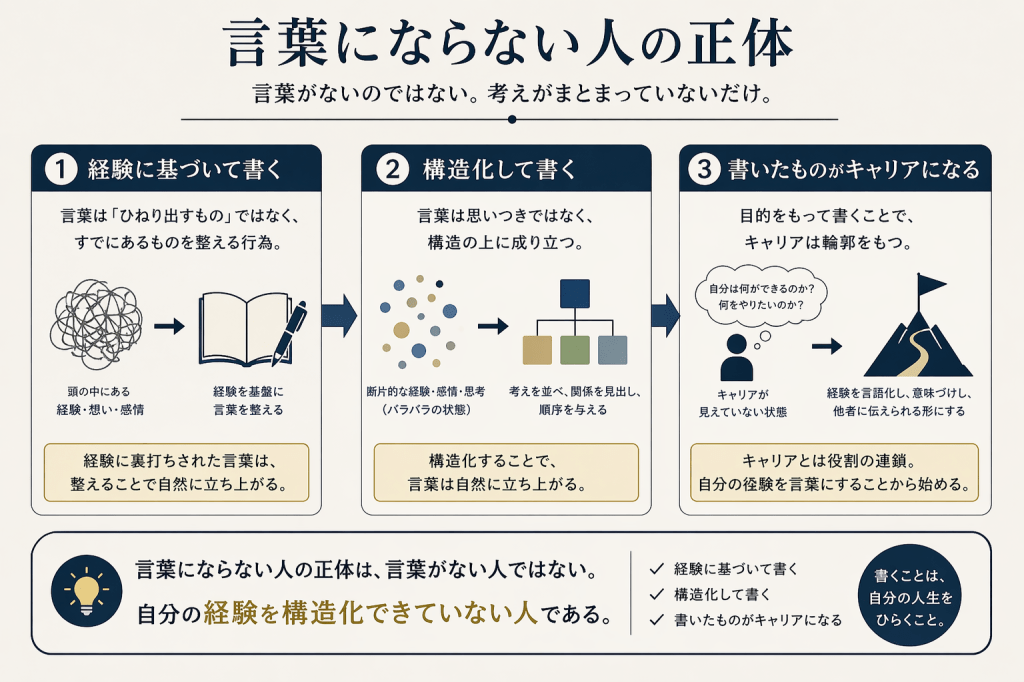
多くの人はここで「自分は言語化が苦手なのだ」と考える。しかし、それは正確ではない。言葉にならないのは能力の問題ではない。むしろ、考えがまとまっていないのである。
断片的な経験や感情が関係づけられないまま並んでいる。その状態では、言葉にしようとしても一つにまとまらない。言葉がないのではなく、まとまっていないだけだ。
では、どうすればよいのか。
① 経験に基づいて書く
多くの人は、言葉を「ひねり出すもの」だと考えている。しかし、言葉とは本来、すでにあるものを整える行為である。その場の思いつきでも成立する話し言葉とは異なり、書き言葉には知識と経験が反映される。
だからこそ、自分の想いや体験を基盤にして言葉を紡ぐ必要がある。経験に裏打ちされた言葉は、無理に作り出すものではなく、整えることで自然に立ち上がる。この営みを、ここではキャリアライティングと呼ぶ。
② 構造化して書く
断片的な経験、バラバラな感情、整理されていない思考。これらが頭の中に同時に存在していると、言葉にしようとしても途中で止まってしまう。
まずは頭の中を整理する必要がある。言葉は思いつきではなく、構造の上に成り立つ。考えを並べ、関係を見出し、順序を与える。その過程を経て、言葉は自然に立ち上がる。
したがって、言葉にならない人の正体は、言葉がない人ではない。自分の経験を構造化できていない人である。
③ 書いたものがキャリアになる
書くことに自信がないという人は多い。しかし、誰もがそれぞれに豊かな経験をもっている。言葉にできない人は、自分の経験や価値を説明できていないだけである。それは非常にもったいない。
大切なのは、目的をもって書くことだ。その目的とは、キャリアを言語化することである。自分の経験を言葉にし、意味づけし、他者に伝えられる形にする。このプロセスを通じて、キャリアははじめて輪郭をもつ。
この言語化ができないと、自分は何ができるのか、何をやりたいのかが曖昧なままになる。いわばキャリアが見えていない状態である。
キャリアとは役割の連鎖である。まずは、これまでの知識や経験を踏まえ、自分の役割を言葉にしてみることから始めたい。
ミッションキャリア・アカデミーhttps://missioncareeracademy.hp.peraichi.com
Many people say, “I can’t put my thoughts into words.”
There is something in their minds. They do have things they want to express and feelings they truly experience. And yet, they cannot turn them into words. All that remains is frustration.
At this point, many people conclude, “I’m just not good at verbalizing.” But that is not accurate. The problem is not ability.
Rather, their thoughts are not yet organized.
Fragmented experiences and emotions remain disconnected. In that state, even if they try to put them into words, they cannot form a coherent whole.
It is not that they lack words—it is that their thoughts are not yet structured. So, what should we do?
1. Write Based on Experience
Many people think that words are something to be “squeezed out.” However, words are originally something to be organized from what already exists.
Unlike spoken language, which can rely on spontaneity, written language reflects knowledge and experience.
That is why we need to build our words upon our own thoughts and experiences.
Words grounded in experience are not forced into existence.
They emerge naturally when we organize what is already there. This process is what I call career writing.
2. Write with Structure
Fragmented experiences, scattered emotions, and unorganized thoughts often coexist in the mind.
In such a state, attempts to express them in words tend to stop midway. First, we need to organize what is in our minds.
Words are not based on spontaneity—they are built on structure.
We arrange our thoughts, identify relationships, and give them order.
Through this process, words begin to emerge naturally.
Therefore, people who cannot put their thoughts into words are not lacking words.
They simply have not yet structured their experiences.
3. What You Write Becomes Your Career
Many people lack confidence in writing.
However, everyone possesses rich experiences in their own way.
Those who cannot express themselves in words are simply unable to articulate their experiences and value. That is a great loss.
What matters is writing with purpose.
And that purpose is to articulate one’s career.
By putting experiences into words, giving them meaning, and shaping them so they can be shared with others, one’s career begins to take form.
Without this process, it remains unclear what you can do or what you want to do.
In other words, your career remains invisible.
A career is a chain of roles. The first step is to put your role into words, based on your past knowledge and experience.


コメントをどうぞ